




Mainly misregistration from feeding offsets, slotting and creasing damage, die-cutting dimension deviations, and ink smearing or paste-up in printing. Proper equipment setup and incoming board quality control significantly reduce reject rates.

Service
Customer-centric: rapid response to your needs, creating long-term value.
Knowledge Base
Q:Which processes generate most carton production waste?
Q:What can be upgraded when automating a carton production line?
Lead-edge feeding systems, on-line plate changing, automatic slotting blade adjustment, on-line waste stripping, automatic counting and stacking mechanisms — reducing labor and improving changeover efficiency.
Q:Is water-based ink eco-friendly?
Water-based ink uses water as a thinner with low VOC emissions — more environmentally friendly than solvent-based ink. Compliant with packaging environmental policies, it is the mainstream ink for corrugated carton printing.
Q:Can limit switches be removed or bypassed?
Never remove or bypass limit switches. They are safety protection components; unauthorized modification risks equipment damage and personal injury. For adjustments, contact the manufacturer’s technicians.
Q:Boards keep feeding skewed — what should I check?
Check vacuum suction power and guide plate positions; inspect feed rollers and rubber rollers for wear; service the suction platform bearings; correct guide plate parallelism and replace worn rubber rollers promptly.
Q:How to protect the ink system during long shutdowns?
Thoroughly clean the ink pump, ink lines and anilox roller to prevent dried ink clogging; wipe rollers clean and apply rust inhibitor to metal parts for long shutdowns.
Q:What are the key daily maintenance tasks for a corrugated printer?
Daily: clean ink residue from rollers and check lubricant levels. Regularly lubricate chains and gears; inspect blades, rubber rollers and bearings; check vacuum lines and cylinder seals; keep maintenance records.
Q:What does the drying system do on a printing line?
It quickly dries water-based ink after printing to prevent ink smearing and color dragging when boards stack. Electric-heat suction drying conveyance offers lower energy use and uniform, stable drying.
Q:What advantages does a dual lead-screw slotting mechanism have over a traditional single screw?
Better synchronization of blade disk lateral movement, faster setup changeover and higher slotting accuracy; less vibration at high speed, lower reject rate, suited to multi-size carton production.
Q:What role does the anilox roller play in a flexo printer?
The anilox roller is the core metered ink-transfer component: its surface cells carry ink and transfer it evenly to the plate. Higher line counts produce finer print detail.
Q:How does vacuum suction feeding work on a printer?
The fan creates negative pressure that holds the board through the air box and suction holes; the conveyor feeds boards smoothly, reducing slipping and skewing for stable registration at high speed.
Q:What is lead-edge feeding and what are its advantages?
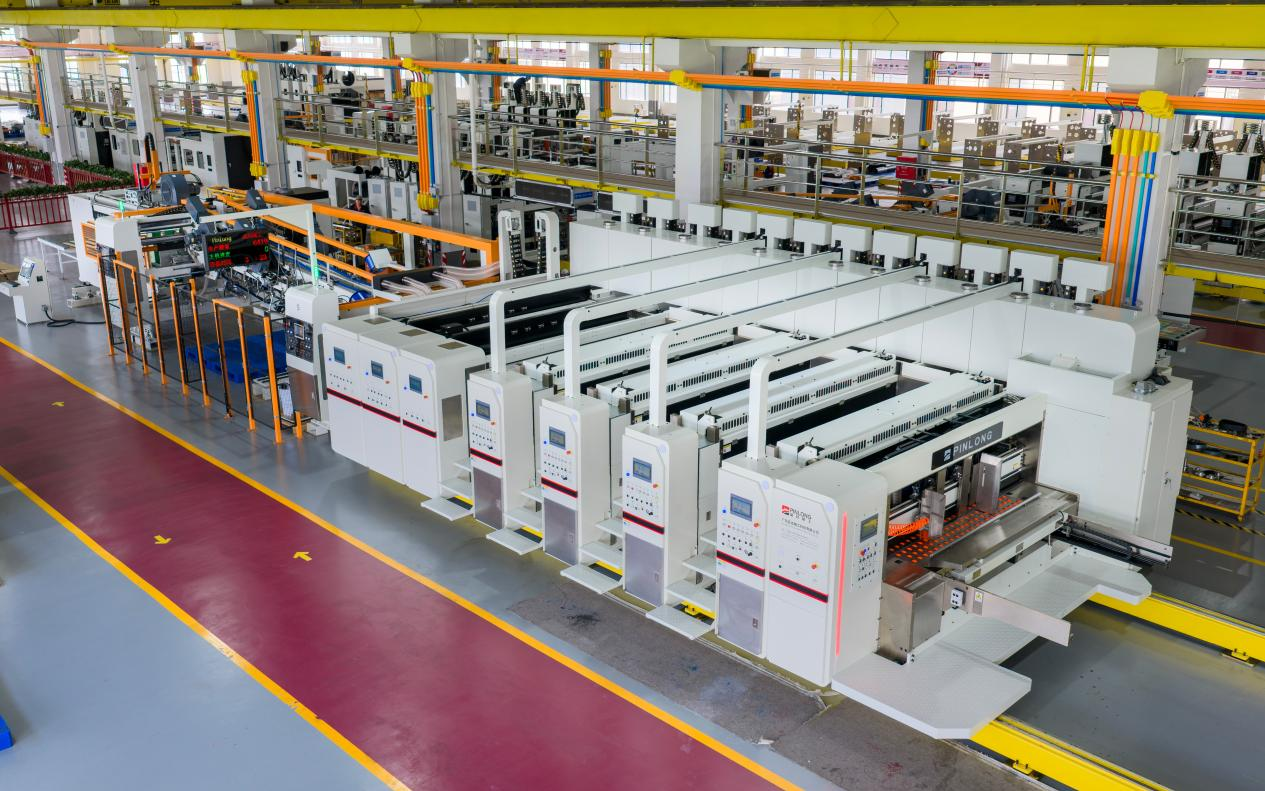
Pinlong’s lead-edge feeding technology grips the leading edge of the board by vacuum suction for conveyance. High positioning accuracy keeps boards from shifting and suits high-speed production; with an adaptive lifting mechanism, it effectively protects corrugation from crushing.
Q:What requirements does flexo printing place on corrugated board?
Board surface dust must be limited and moisture content kept in a reasonable range. Over-dry board cracks at creasing; damp board causes slow ink drying, ink smearing and color dragging.
Q:What is the difference between pre-printing and post-printing?
Pre-printing: print on liner first, then laminate into corrugated board — high graphic precision. Post-printing: flexo-print directly on the corrugated board — the most widely used process in carton plants, with a shorter workflow and better cost performance.
Q:How to handle large slotting dimension deviations?
Check slotting blade disk fastening, disk synchronization and whether boards feed straight; on multi-disk machines verify lateral synchronization and recalibrate disk positions.
Q:What causes cracking at slotting and creasing lines?
Main causes: creasing gap too small, low board moisture content, insufficient liner strength. Enlarge the creasing gap appropriately, humidify the creasing area, or use better-quality board.
Q:How to fix plate smearing (paste-up) in corrugated printing?
Paste-up is usually caused by excessive ink supply, high ink viscosity or slow drying. Reduce ink supply, adjust ink viscosity, add retarder additives, and properly control printing bottom pressure.
Q:What causes poor color registration?
Common causes: unstable feeding, air pressure fluctuation, insufficient plate tension, board deformation, or abnormal printing unit synchronization. Check in turn the vacuum suction system, cylinder pressure, plate fixing and board moisture content.
Q:What is the difference between flexo printing and offset printing for cartons?
Flexo printing uses water-based ink to print directly on corrugated board — fast and low-cost, the mainstream process in the carton industry. Offset is mostly used for pre-printing liner faces with fine detail but high equipment investment, and generally does not print directly on finished corrugated board.
Q:Is a wider printing machine always better? How to choose?
Not necessarily. Choose primarily based on your factory’s mainstream carton sizes. Larger width means higher purchase cost, floor space and energy consumption; if large boards are rarely produced, machine capacity sits idle.